About Us
Our Story
iCount was inspired by a true patient story shared here and the recurring incidents of avoidable harm caused by retained surgical swabs.
- The innovation was nurtured within the NHS by NHS Clinicians supported by Keele and Wolverhampton Universities,
Subsequently, it had to be transitioned into a small, clinician-led enterprise to enable manufacturing, regulatory readiness, and wider adoption, while remaining firmly rooted in NHS values.
Co-founders used their own funds primarily and were also supported by highly competitive national grants from Innovate UK to fund some of the development.
Since one of the co-founders felt that she needed a better understanding of human factors-ergonomics and systems thinking during the development phase, she did a University qualification after enrolling into a Master’s course.
- R&D of a medical device is arduous and resource-intensive
- The costs of iterative engineering development, intellectual property management, regulatory and testing ran into hundreds of thousands of pounds.
The development took 8 years with 18 prototypes and many cycles of simulation and human factors usability. Many of the simulations were done independently by NIHR HRC.
- We have international granted patents and international publications in reputed journals like the BMJ.
- The system has also been designed with sustainability in mind, reducing carbon impact in life cycle analysis, with a bioplastic option available for trusts prioritising environmental impact.
Given the national focus on maternity and surgical safety and reducing avoidable harm, we believe iCount offers a practical, immediately deployable enhancement to existing safety and governance frameworks.
Our R&D journey and the value of simplicity
How it all came about
A real patient story

Our Mission
Our mission is to transform patient safety by ensuring smarter protocols that aim to eliminate Never Events.

Our Vision
Ensuring Every Count, Protecting Every Patient – because no mistake is acceptable when it comes to surgical safety.
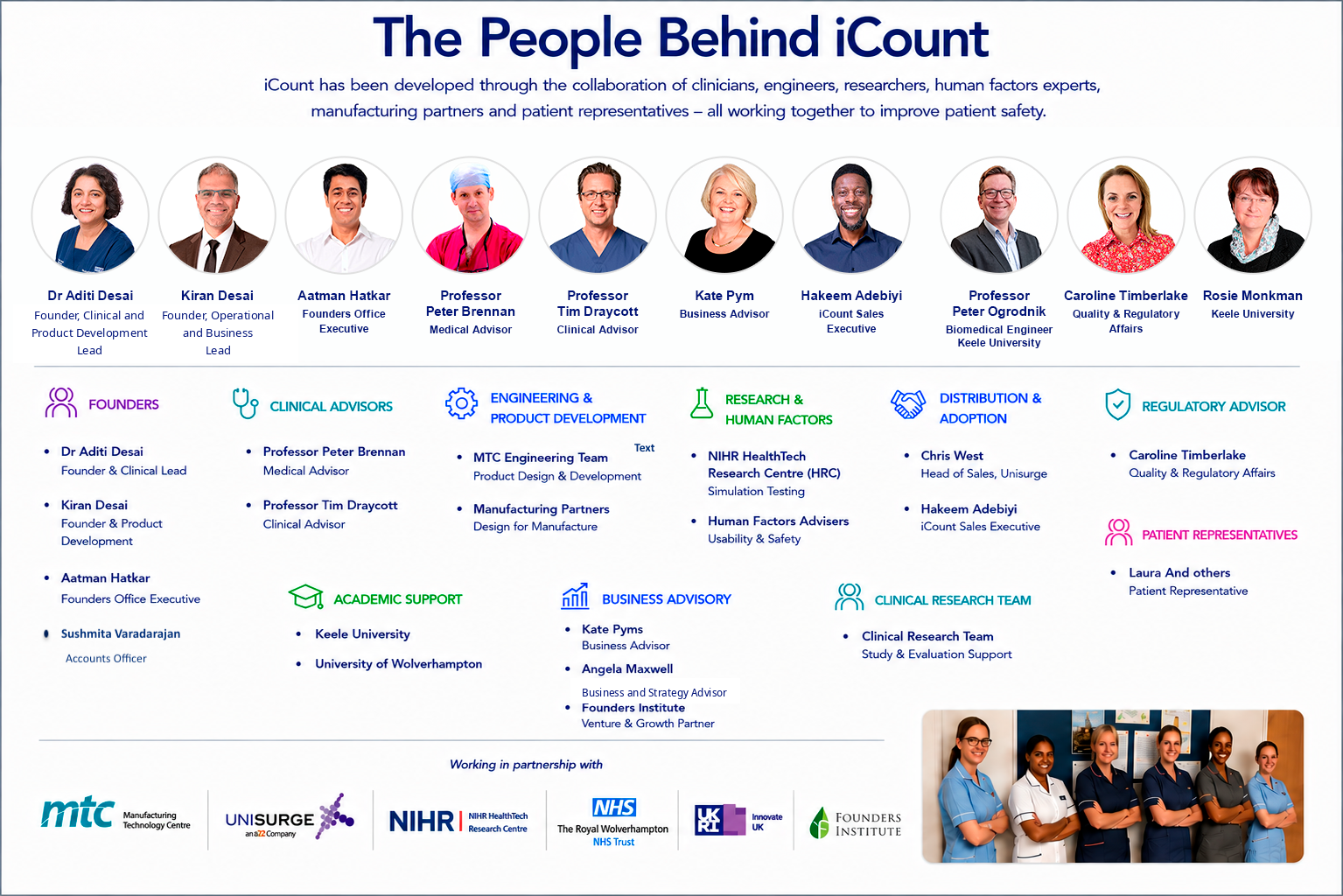
Meet Our Team
Meet the team of clinicians and innovators driving change in the MedTech space.
The Hidden Crisis in Surgical Safety.
Retained surgical swabs are the single most common cause of avoidable harm in surgery and childbirth, leading to severe patient suffering, systemic failures, and financial burdens for healthcare providers.

-

557 surgical swabs retained in the UK between 2012-2022.
-

39 never events occur weekly in the US, with 68% being retained swabs.
-

£70M in NHS litigation payouts over 10 years.
-

Worldwide cost of $2.1 billion annually.